Moral Fragmentations and Boundaries
This event through the Consortium on Moral Decision-Making will bring together several scholars in the social sciences and humanities to talk about different disciplinary approaches to the study of “fragmentations” and moral boundaries. The event will be headlined by three keynote talks: philosophers Michael Brownstein (who is a Penn State Philosophy Ph.D. alumnus) and Daniel Kelly on their new book Somebody Should Do Something (on philosophy and social science of collective action), philosopher Matt Lindauer on his new book The Fruitfulness of Normative Concepts (on the practical relevance of philosophical ethics for social life), and policy and Rock Ethics scholar Ben Jones on his new book on the ethics of policing, Protecting Life: The Ethics of Police Deadly Force. Scholars from anthropology, psychology, philosophy, history and religious studies, public policy, and management and organizations will convene to work through and build each other’s thinking to highlight the value of collaborative, constructive conversation.
The event will be held downtown at the Innovation Hub, with coffee and refreshments provided, and also live-streamed. We encourage all who are interested in the exciting interface at the boundaries of our fields to check out this event.
AI in Social Research
Empathic AI, Metascience, and Methodology
This two-day interdisciplinary event will bring together researchers from psychology, political science, philosophy, computer science, and related fields to explore the intersection of artificial intelligence and social research. The conference will feature invited talks, panel discussions, and a closing roundtable.
Upcoming Events
This two-day interdisciplinary event will bring together researchers from psychology, political science, philosophy, computer science, and related fields to explore the intersection of artificial intelligence and social research. The conference will feature invited talks, panel discussions, and a closing roundtable.
This event through the Consortium on Moral Decision-Making will bring together several scholars in the social sciences and humanities to talk about different disciplinary approaches to the study of “fragmentations” and moral boundaries. The event will be headlined by three keynote talks: philosophers Michael Brownstein (who is a Penn State Philosophy Ph.D. alumnus) and Daniel Kelly on their new book Somebody Should Do Something (on philosophy and social science of collective action), philosopher Matt Lindauer on his new book The Fruitfulness of Normative Concepts (on the practical relevance of philosophical ethics for social life), and policy and Rock Ethics scholar Ben Jones on his new book on the ethics of policing, Protecting Life: The Ethics of Police Deadly Force. Scholars from anthropology, psychology, philosophy, history and religious studies, public policy, and management and organizations will convene to work through and build each other’s thinking to highlight the value of collaborative, constructive conversation.
The event will be held downtown at the Innovation Hub, with coffee and refreshments provided, and also live-streamed. We encourage all who are interested in the exciting interface at the boundaries of our fields to check out this event.
During this event, we will bring together several speakers to discuss measurement and methodology questions in the study of moral decision-making. Speakers will deliver short-talks, along with roundtable discussions.
Speakers include:
- Nick Byrd, Ph.D. (Geisinger Health Systems)
- Paige Amormino, PhD. (Penn State, Prevention Research Center)
- Vlad Chituc, Ph.D. (Yale University)
- Raluca Szekely, Ph.D. (Romanian Academy)
- Faruk Yalcin, M.S. (Penn State, Psychology)
- Becca Ruger, M.S. (Penn State, Psychology and Social Data Analytics)
- Jillian Meyer, B.A. (Indiana University, Psychology and Cognitive Science)
- Ben Hardin, B.A. (Washington University in St. Louis, Psychology)
“Seeing Animals: The Evolving Role of Animal Photojournalism in Advocacy and Culture Change”
In this presentation, Jo-Anne McArthur explores the emerging genre of Animal Photojournalism (APJ)—a field that documents the lives of animals living in the shadows of human industry. While photography of animals has historically focused on wildlife, conservation, and companion animals, APJ centers on the animals used in our food systems, for entertainment, research, and labor. In other words, the animals whose lives are inextricably linked to ours.
McArthur discusses how compelling, rigorous visual storytelling can act as a catalyst for ethical and cultural shifts. By bringing these “invisible” animals into the light of the public eye, animal photojournalism challenges the anthropocentric gaze and provides the evidence-based media necessary to accelerate systemic change. The talk examines the power, the challenges, and the limitations of APJ to spark change at the personal and the political level.
Jo-Anne McArthur Bio
Title: Photojournalist, President and Founder
Jo-Anne is an award-winning photojournalist, sought-after speaker, photo editor, and the founder of We Animals. She has visited over sixty countries to document our fraught relationship with animals and is the author of three books: We Animals (2014), Captive (2017), and HIDDEN: Animals in the Anthropocene (2020). Jo-Anne is the subject of the acclaimed Canadian documentary, The Ghosts in Our Machine, and her photographs have received accolades from Wildlife Photographer of the Year, Nature Photographer of the Year, Big Picture, Picture of the Year International, the Global Peace Award, and others. Jo-Anne enjoys jurying photo competitions and has done so for World Press Photo, Big Picture, and others. She hails from Toronto, Canada.
In addition to Jo-Anne McArthur’s talk, there will be opening remarks by Daryl Cameron (Associate Professor of Psychology, Sherwin Early Career Professor and Senior Research Associate in the Rock Ethics Institute), who directs the Empathy and Moral Psychology Lab (https://emplab.la.psu.edu/) and the Consortium on Moral Decision-Making (https://moralconsortium.psu.edu/), on choices to empathize with animals. There will also be remarks by Ivy Gilbert (PhD candidate in Psychology, Cornell University; https://www.ivytgilbert.com/). After Jo-Anne McArthur’s talk, there will be a panel discussion about empathy and seeing animals, with moderated Q+A from the audience (both in-person and online).
Joint lab meeting between the Empathy and Moral Psychology Lab (Dr. Cameron) and Morality and Social Cognition Lab (Laurent).
Speaker: Zachariah Berry (Assistant Professor of Management and Organizations, University of Southern California Marshall School of Business)
Speaker Bio: Zachariah Berry studies morality at work. His current research explores how people 1) think about moral character, 2) ascribe morality to their work and relationships, and 3) think about and navigate conflicts between their values. He is also interested in diversity and the experience and consequences of giving up on career pursuits. His research has been published in leading academic journals such as Organization Science, Journal of Personality and Social Psychology, Management Science, and Nature Human Behaviour among others. He has also authored several articles for Harvard Business Review. He received his Ph.D. in organizational behavior from Cornell University, master of arts degree in psychology from the University of Chicago, and dual bachelor of arts degree in psychology and philosophy from Bethel University.
Talk Title:“Demographically Diverse Teams are Perceived as Less Corruptible”
Talk Abstract: Demographic diversity is a salient feature of teams, shaping how third-party actors perceive and interact with them. Although diverse teams are frequently seen as having conflicting values and viewpoints that can create challenges for the team, we propose that this perceived conflict is viewed as a strength in the moral domain. Across five main studies and eight supplemental studies utilizing different paradigms and stimuli (N = 3,970), we find that people evaluate diverse (vs. homogeneous) teams as less corruptible because they are considered to have higher ethical conflict—disagreements over how to think about and navigate moral issues. We further demonstrate that these perceptions are consequential and impact behavior as they influence how people create teams with different moral motives. Finally, we explore two areas in which people show a preference for homogeneous teams. Together, these findings suggest that perceived ethical conflict in diverse teams is less a challenge to be managed, and instead a signal of moral strength that influences how people judge, construct, and align with teams in consequential ways.
The Consortium on Moral Decision-Making is hosting a spring kick-off reception. All are welcome, whether they are returning affiliates or new people who maybe want to learn more about ethical and moral decision-making through an interdisciplinary lens.
Please share with colleagues who may be interested in getting involved with our research, conference outreach, or simply learning more.
The weekly meeting of the Empathy and Moral Psychology (EMP) Lab, directed by Daryl Cameron in the Department of Psychology. We will discuss research articles and in progress projects. Email Professor Cameron (cdc49@psu.edu) if you’d like a Zoom link to attend virtually.
This presentation examines the philosophical assumptions underlying how researchers define and study empathy and the self. I will interrogate what we mean by “perspective-taking,” and the implications these meanings carry for empirical work. In practice, does perspective-taking actually entail that the self subsumes the other—projecting one’s own opinions, beliefs, emotions, and sacred values onto them? Or does it mean that the self is subsumed by the other – becoming so porous that it loses fidelity to its own core commitments? As Levinas reminds us, the other is never fully graspable within the terms of the self, complicating assumptions about what empathy can achieve. I will introduce a conceptual model that supports genuine perspective-taking while maintaining fidelity to the self, fostering empathy that honors both self and other. This model encourages principled, collaborative solutions—even in polarized contexts—and opens the door for interdisciplinary engagement.
How Can We Improve Our Decisions? Results From Multiple Methods And Experiments
Nick Byrd, Ph.D.
Assistant Professor of Cognitive Science
Geisinger College of Health Sciences
Department of Bioethics and Decision Sciences
Nobel laureates like Daniel Kahneman popularized research about cognitive biases. To better understand and ameliorate these reasoning errors, we have been developing more scalable methods to (a) trace reasoning processes and (b) improve faulty reasoning. So far, we have run at least a dozen experiments involving thousands of participants. Consider some examples:
Thinking aloud is a common critical thinking exercise in education, computer science, and other analytic decision-making contexts. Alas, legacy methods of recording people as they think out loud are time consuming. Also, thinking aloud may use cognitive resources that could otherwise be spent on improving decisions. To address these issues, I partner with startups to develop web apps that remotely (and consensually) record and transcribe people’s reasoning process (e.g., from the microphone on the participants’ smartphone), which drastically expedited data collection and transcription — from months to hours. Behavioral results have improved our understanding of what reflection tests measure and how people overcome faulty intuitions.
Debate is supposed to enhance intelligence analysis, policymaking, and other forms of critical thinking. However, facilitating debates require significant human resources. So, we developed web apps to automatically facilitate solitary and discussion-based reflection with varying financial incentives. This allows hundreds of debates to be recorded in parallel from afar, drastically accelerating data collection and transcription. Our quantitative decision analyses find that conversation can be better than cash in terms of improving decisions.
Our thinking-aloud, writing, and chatting protocols also yielded decision transcripts that contain much more information than standard survey data. Research assistants, crowd workers, and language models can categorize and quantify aspects of these step-by-step decision records. The resulting ratings allow us to quantitatively test the assumptions of cognitive tests and isolate which reasoning patterns actually predict better decisions.
We are also testing interventions such as information formatting (e.g., argument mapping or data visualization), philosophical reflection (e.g., thought experiments), testing effects (e.g., having people complete some reasoning test items before the primary test of reasoning), nudges (e.g., text message reminders), and boosts (e.g., educational infographics).
Ultimately, few interventions reliably improve decisions. And some popular interventions seem ineffective in improved research designs (e.g., with larger samples, better data, better measures, or more controlled variables). This presentation will dive deeper into the methods and results.
For Zoom link email Daryl Cameron at cdc49@psu.edu.
This retreat for the Consortium on Moral Decision-Making will include internal and external affiliates, and is aimed at cultivating conversation about interdisciplinary projects related to moral decision-making. It’s open to faculty and students from across departments here at Penn State. The Consortium is supported internally through funding from the Rock Ethics Institute, Social Science Research Institute, College of the Liberal Arts, The McCourtney Institute for Democracy, and the Departments of Philosophy and Psychology. Even if you have not joined us previously as an internal or external affiliate, please feel free to attend.
If you are remote, please contact Daryl Cameron, the Consortium’s Director, for the Zoom link.
We will be joined by Valerie Tiberius (University of Minnesota, Philosophy) and Simone Shamay-Tsoory (University of Haifa, Psychology). They will each give talks on empathy, learning, and wisdom, and then talk with each other, and take questions from the webinar audience.
Sara Konrath (Indiana University, Psychology) and Fritz Breithaupt (Indiana University, Germanic Studies) will each give talks and then talk with each other about the positive and negative aspects of empathy in social life, and take questions from the webinar audience.
We will be joined by Phillip Kanske (TU Dresden; Psychology and Neuroscience) and Leda Berio (Ruhr University Bochum; Philosophy). They will discuss the nature of empathy, each presenting talks on their work and then discussing interdisciplinary considerations about empathy with each other and the webinar audience.
This event will bring together researchers in psychology, political science, communication, philosophy, sociology, and anthropology to discuss political divisions and moral decision-making. The event will be in person at Foster Auditorium on campus, with live-streaming on Zoom as well. The aim of the conference is to cultivate cross-disciplinary dialogues about this topic and generate new research collaborations.
Past Events
Moral Measures Workshop
This event will bring together researchers to give short talks on methodology and measurement questions in the study of moral and ethical decision-making. Although many of our conference events have focused on theory development and new empirical findings, this is the first Consortium event that has focused specifically on methodology as the sole focus. We aim for this long-form workshop to be the first of several that directly address how best to conceptualize, think about, and test questions about moral decision-making.
How Can We Improve Our Decisions? Results From Multiple Methods And Experiments
Dr. Nick Byrd (Geisinger Health System) visited the Consortium virtually to discuss his work on cognitive reasoning, philosophical thought experiments, and public-focused decision-making. Click here to watch the video of his talk.
Political Divisions and Morality: An Interdisciplinary Conversation
This event will bring together researchers in psychology, political science, communications, philosophy, sociology, and anthropology to discuss political divisions and moral decision-making. The event will be in person at Foster Auditorium on campus, with live-streaming on Zoom as well. The aim of the conference is to cultivate cross-disciplinary dialogues about this topic and generate new research collaborations.
Dr. Cameron Leads PRC Seminar on “Empathic Choices and Interdisciplinary Moral Psychology”
Dr. Cameron visited with the Edna Bennett Pierce Prevention Research Center and gave a talk on his work on motivated empathy regulation, and also discussed the interdisciplinary vision behind the Consortium on Moral Decision-Making. For more about the talk topic: https://prevention.psu.edu/event/seminar-with-daryl-cameron-ph-d.
Moral Snowballing: Confluences in the Depth and Breadth of Moral Concern
Joshua Rottman (Psychology at Franklin & Marshall College, and Fellow in Oxford Uehiro Center for Ethics) visited Penn State to talk about his research on the depth and breadth of moral concern. Watch the presentation below.
Moral Psychology Research Group/Consortium Conference 2024
In November 2024, the Consortium on Moral Decision-Making will be hosting a cross-over event with the Moral Psychology Research Group (https://sites.google.com/view/mprg/home), an interdisciplinary group of philosophers and psychologists. The aim of the conference was to bring together scholars from across the social sciences and humanities to have interdisciplinary conversations and build collaborations that advance the study of ethical and moral decisions.
Expanding Empathy: Empathy, Morality, and AI
How does AI provide, sustain, support, and challenge empathy? In April 2024, we brought together psychologists, philosophers, engineers, and computer scientists to discuss the interdisciplinary challenges of empathy and morality in human-AI interactions. Speakers visited in person and online from around the world.
Political Polarization Hack-a-Thon
We convened several researchers in psychology, political science, media studies, communication arts and sciences, and sociology to brainstorm new actionable ideas in political polarization and morality.
Consortium Seed Grant Presentations
Many of the seed grant award teams presented on their projects.
Seed Grant Talk: Empathy and Ovarian Hormones
David Puts (Professor in Anthropology) talked about his seed-grant funded work with Sojung Bank and colleagues on empathy and the activation of ovarian hormones. Watch the presentation below.
Seed Grant Talk: Empathic Signaling and Social Capital Among Bangladeshi Women
Sojung Baek (doctoral candidate in Anthropology) talked about her seed grant-funded work with David Puts (Anthropology) and others.
When “not caring” makes little sense
Dr. Sean Laurent (Assistant Professor in Psychology) presented in progress work related to democratic virtues and decision-making called “When ‘not caring’ makes little sense: The role of desire in moral character judgments of side-effect effects”.
What Impact Does Race Have on Support for Public Safety Alternatives to the Police?
Dr. Ben Jones (Assistant Professor of Public Policy, Assistant Director of Rock Ethics Institute) talked about a project examining race, policing, and policy alternatives.
Civic Education for a Serious People
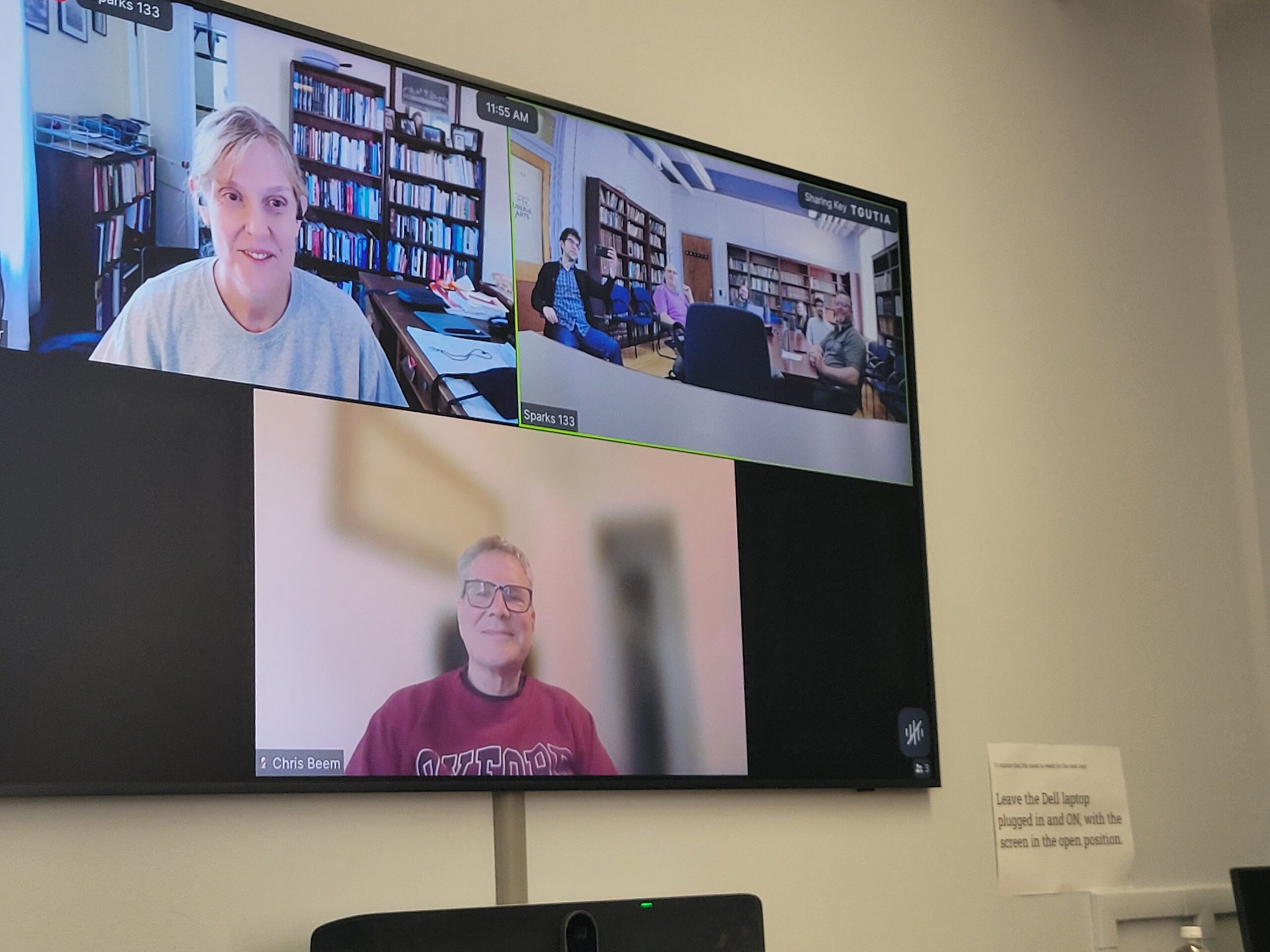
Dr. Christopher Beem (Associate Research Professor and Managing Director, McCourtney Institute for Democracy) presented in progress work related to democratic virtues and decision-making called “Civics Education for a Serious People: 2 Proposals”. This meeting built from our previous meeting, in which we convened several different researchers to discuss complementary approaches to studying political polarization, with the aim of cultivating new projects.
Consortium Meeting on Political Polarization
During this meeting, faculty and graduate students had some great discussion surrounding our multidisciplinary interests in political polarization.
We are hoping that this meeting was a valuable starting point for considering grant applications, long term projects, etc.
First Consortium Meeting of the Semester
Dr. Terri Vescio, Professor of Psychology, presented a talk discussing idealized notions of masculinity that are culturally valued and linked to power, status, and success. She discussed the role of empathy in the socialization of masculinity. She also discussed the causes and consequences of threats to masculinity, with a specific focus on empathy and the sexualization of women.